


No products in the cart.
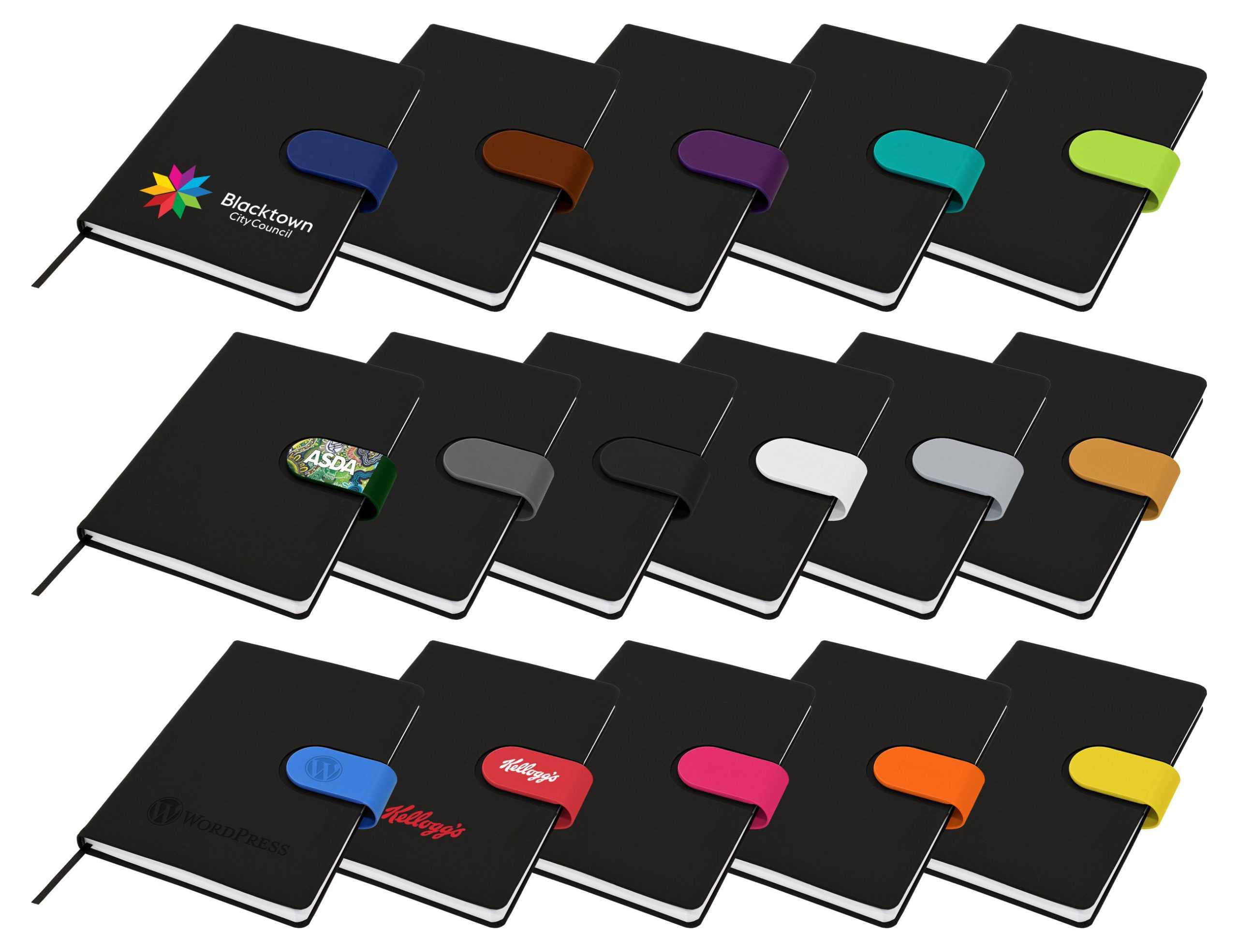

Open the bottom drawer of almost any desk. You’ll find them. Three notebooks, each a third full. One has a cracked spine. One was too big for the bag. One nobody remembers buying.
That drawer is the real cost of a poor choice. It isn’t the price on the invoice. It’s that the notebook never suited the job, so nobody reached for it.
This guide helps you skip the drawer. It walks through the different types of notebooks, from covers and binding to page style and size, and matches each one to a real business need. Plain words. No fluff.
Most of us pick a notebook with our eyes. Colour first, then feel. Before you compare types of notebooks, four questions work better.
It also helps to picture the moment it gets opened. A quick phone message is a different job from a planning meeting that runs all morning. The first needs something close at hand. The second needs room to think.
Answer those, and the choice narrows fast. Everything below is just a way of matching your answers to a notebook.
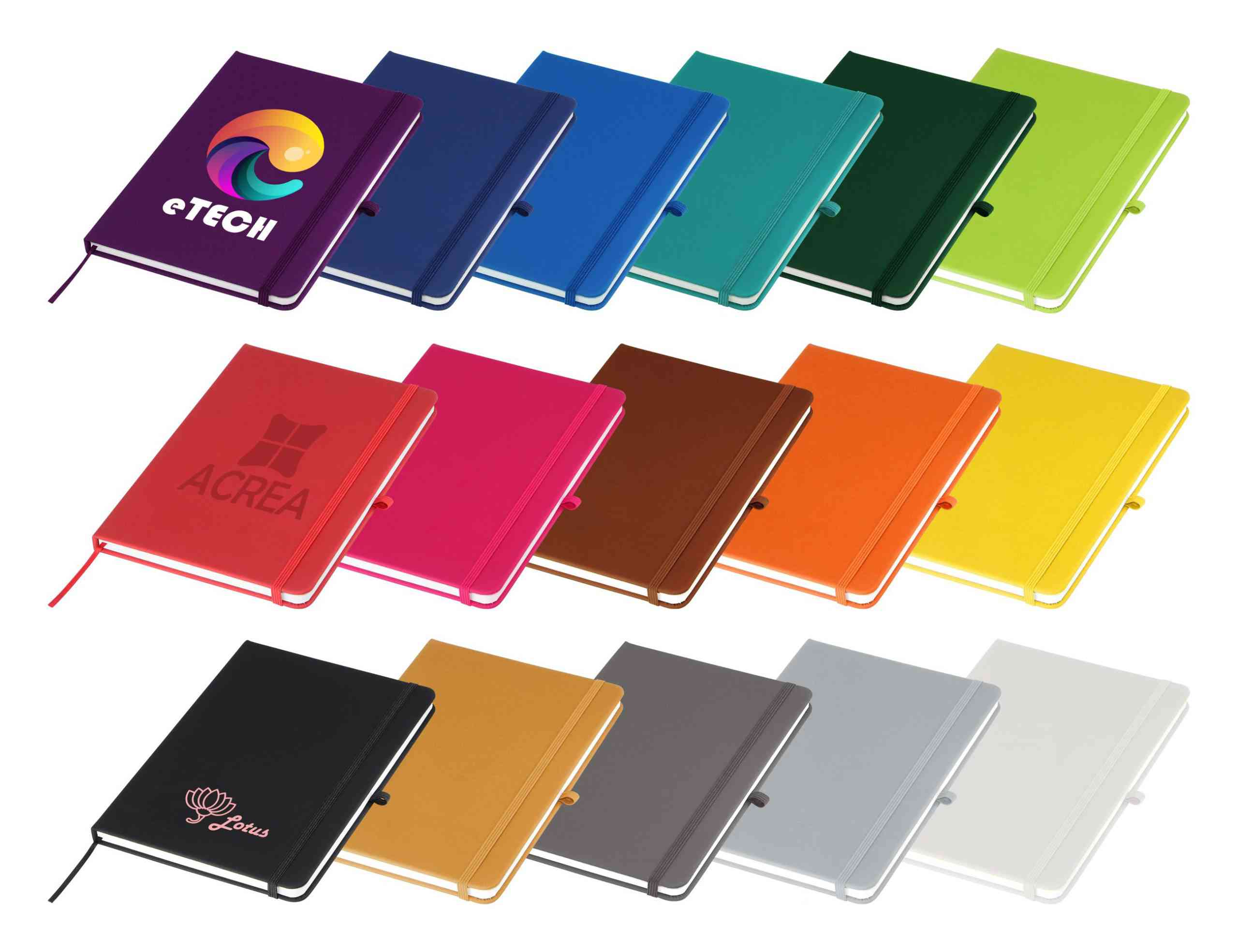
The cover does the heavy lifting. It decides how a notebook feels, how it travels and how well it survives a bag.
Our range of notebooks and pads includes all three styles. At the time of writing, it lists 24 items, from slim softcovers to A4 notepads. Here is how they compare.
A firm board cover protects the pages and gives the notebook some weight. It looks serious on a boardroom table.
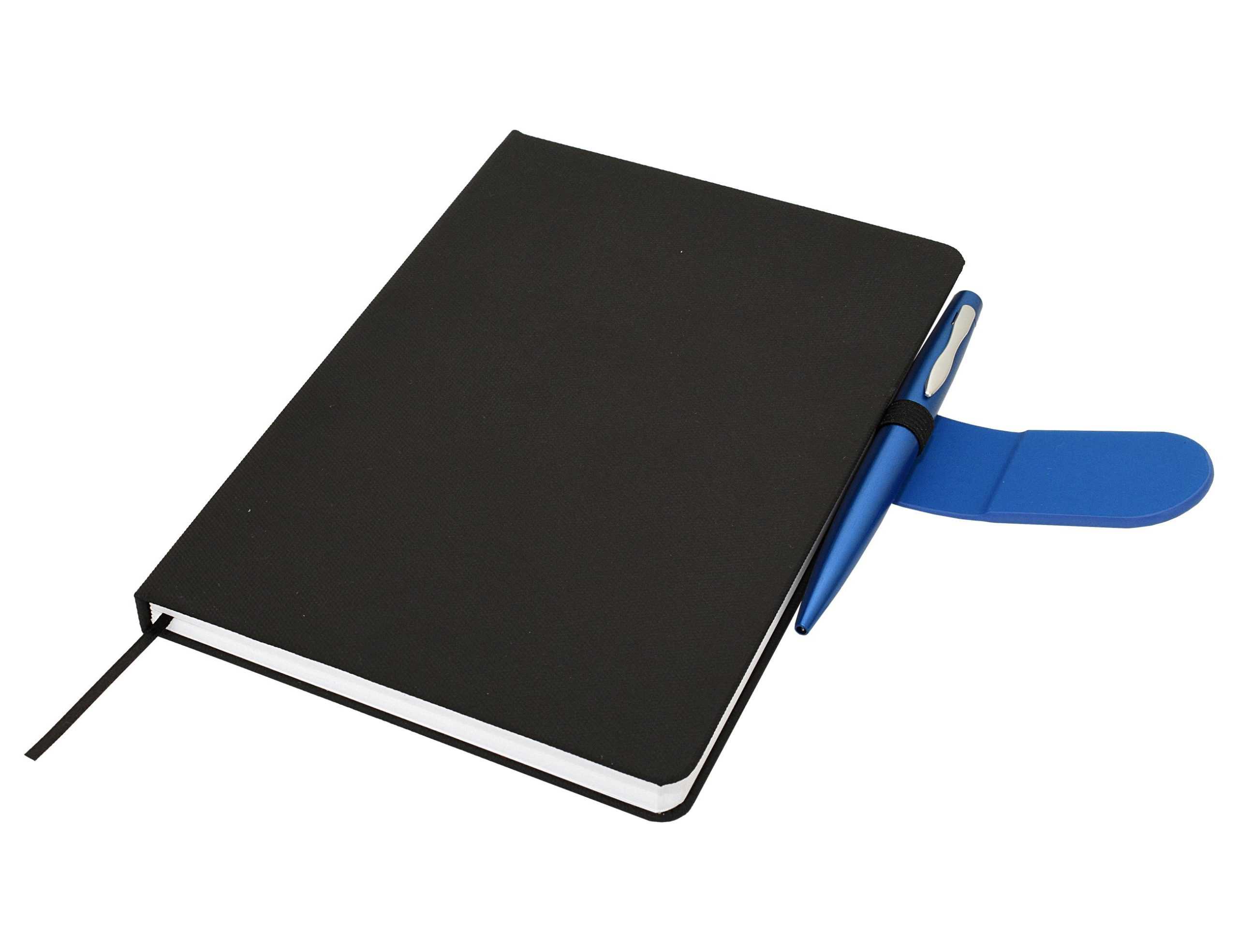
The Cordoba A5 Notebook is a good example of a hardcover notebook. It has a hard cover in vegan leather (PU), a pen loop, a ribbon marker and a snap-on magnetic closure. Matt black keeps it looking professional in a meeting, and the pages are recycled paper. The Carnival Pro A5 also has a hardcover in vegan leather (PU).
For client meetings, an A5 hardcover notebook is the safe pick. It sits neatly besides a laptop and doesn’t flop about in a bag.
Soft covers bend, which makes them friendlier in a jacket pocket. The Genesis A5 has a soft PU cover and a ribbon marker. The Camri and Elantra have soft-touch PU covers and just 32 leaves. A leaf is one sheet, so that’s 64 pages, and the notebooks stay slim.
Slim is handy. A thin notebook won’t weigh down a delegate’s bag, and it’s easy to keep.
Kraft and cardboard look natural and understated. The Venture A5 Natural has a kraft paper cover over cardboard, with a neutral elastic strap, a pen loop and a page marker. The Reflex Small and Large also have cardboard covers, and their product pages describe them as eco-friendly.
Binding is easy to overlook. It shouldn’t be. It decides whether a notebook lies flat, whether pages stay in and how tidy the spine looks after a month of use.
Good notebook binding quietly does its job. There are many types of book binding, from perfect and case-bound to wire, coil and comb. For everyday business notebooks, three are worth knowing.
Perfect binding glues the pages along the spine. It gives a clean, book-like edge. The Reflex Notebook Small and Large are both perfectly bound, with a cardboard cover and 60 leaves (120 pages) of 70gsm lined paper.
Spiral and wiro (also written wire-o) bindings open all the way round, so the notebook lies flat on a desk. That makes writing easier at a counter or on a clipboard.
Among the types of spiral notebooks, you’ll mainly see coil (often just called spiral) and wiro. Coil is tough and flexible. Wiro looks a little sleeker.
The Allegro Notebook is wiro bound, with a kraft paper cover and 120 lined pages. Its product page calls it an eco medium-size notebook with a pen loop, and at 146 x 179 mm it is shorter than A5.
Our eco range also includes a spiral-bound notebook, the Tradie Cardboard Notebook with Pen. It has an unbleached cardboard cover, 60 sheets of lined paper and a pen loop with a recyclable paper pen. At 77 x 130 mm it is a true pocket size, and the pages are perforated.
Which of these notebook binding types suits you depends on how you write. Flat-lying options suit desks and counters. Glued spines suit a tidy shelf.
Size is always a trade-off. Big pages give you room. Small ones go anywhere.
A5 paper is 148 x 210 mm. That’s half of A4, which is 210 x 297 mm. Finished notebooks come out slightly different because of the cover and trim. The Venture A5 measures 140 x 210 x 15 mm, and the Genesis A5 measures 145 x 210 x 15 mm.
It is the most common size in our range, and for good reason. It fits a bag, a desk and most hands. For most desks, the A5 notebook size is the sweet spot.
When you compare notebook sizes, remember that a thick cover adds bulk. Here is how the others stack up:
A simple rule helps. If the notebook lives on a desk, go for A5 or larger. If it lives in a pocket, go small. If it moves between the two, ‘medium’ is the middle ground.
Open any notebook, and the pages are what you actually use. They deserve as much thought as the cover.
Ruled lines keep handwriting tidy. Plain pages suit sketching. Dotted and grid pages sit somewhere in between. Where our product pages state a page style, it is lined.
For a business giveaway, a lined notebook is the safe choice. Nobody needs a tutorial. The A5 lined notebook is the classic version. The Venture A5, for example, has 96 leaves, or 192 lined cream pages.
Paper is the part your pen touches. Weight is measured in gsm, which stands for grams per square metre. Typical office paper is 80gsm. Many notebooks in our range use 70gsm cream paper, and the Diano uses 80gsm lined paper. Cream gives a warmer, more classic look.
Waste is on a lot of buyers’ minds. A recycled notebook is an easy way to show you care.
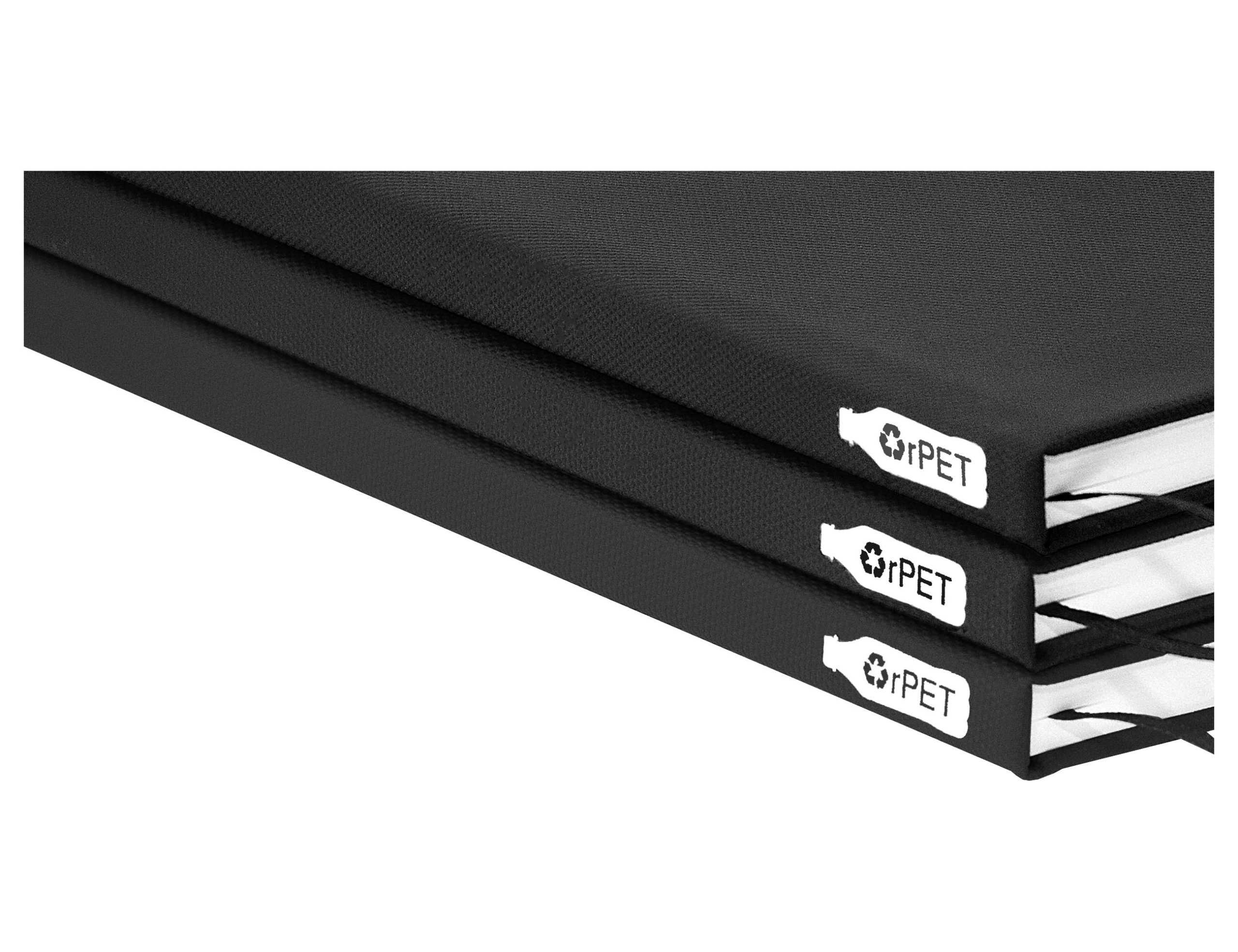
The Bio Plus rPET A5 Notebook has a hard cover made from recycled PET. Its product page says the PET is sourced from items like used water bottles. The pages are recycled paper too. It fastens with a snap-on magnetic closure, and as a hard cover A5 it keeps a firm, professional feel.
One tip. Ask what is actually recycled: the cover, the paper or both. The answer changes what you can honestly say about it.
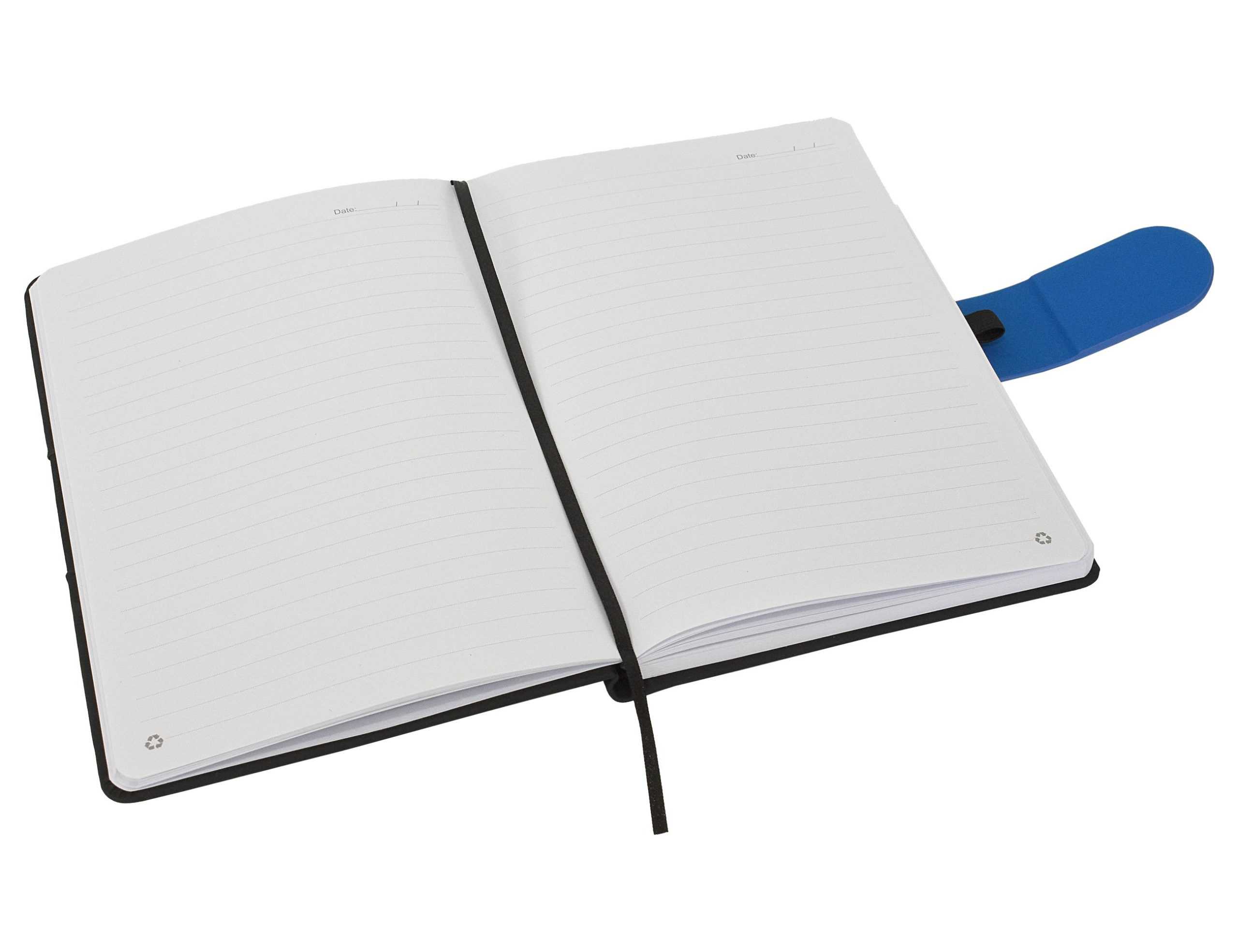
Short answer: yes, if people write on the move. A loose pen goes missing. A pen with a home stays put.
Our product pages call it a pen loop. The Cordoba, Venture Supreme, Venture A5 Natural, Allegro and Tradie all have one. The Carnival Plus has a pen loop too, but the pen is extra.
A few other extras are worth a look:
None of these is essential. Pick the ones that match how the notebook will be used.
Not every job needs a cover.
The types of notepads in our range differ mostly by size. They come in A6, A5 and A4, measuring 105 x 148 mm, 148 x 210 mm and 210 x 297 mm. Each has a solid strawboard backing. Page counts start at 25 or 50 pages, or you can specify what you need.
Choose a pad when the notes are short-lived. Choose a notebook when they need to be kept.
Here is the cheat sheet. Each scene below starts with “picture a” because these are examples, not real clients.
If you’re torn between two, pick the one you’d use yourself. That test rarely fails.
Another shortcut: ask the people who will carry it. Two minutes with a few staff will tell you more than any spec sheet. Do they write standing up? Do they lose pens? Do they need to slip it into a back pocket? Their answers point straight at a size, a cover and a binding.
A wrong choice usually comes down to one of four traps.
Pick the notebook for the people using it, not the person placing the order.
A few practical points save time later. Our FAQs page has the full detail, but here is the short version.
Our range is quote-based, so there’s no checkout. You browse, click Add to Quote and send the request. Our team replies with pricing within 1 business day.
Tell us who will use the notebook and where. That one detail helps us suggest the right size, cover and binding.
A clean artwork file saves days. Send the right one first and the job moves faster.
Work backwards from the day you need the notebooks in hand. Then add a little buffer, because a proof can take a round of changes.
Picture a conference on the 30th. Count back through production, dispatch and freight, and you can see why early ordering matters. Leave the notebook decision until the week before and standard production alone won’t fit inside it.
The right notebook is the one that gets used. Start with the job, pick a cover and binding to match, then check the size and pages. Do that and that drawer stays clear.
You don’t have to work it out on your own, either. Hype Promotions is a family business, 100% Queensland-owned and operated, and run by directors Jo and Fred Madgen. Jo has more than 30 years in the industry and Fred more than 18, so there’s a good chance they’ve seen a brief like yours before.
Need a hand choosing? Get in touch with our team. Tell us who the notebooks are for, how many you need and when you need them. We’ll shortlist options that fit, quote them, and take care of the artwork proof, production and delivery to metropolitan and regional areas across Australia. We’ve been putting together branded merchandise for Australian businesses since 1988, and we’re always happy to talk it through.
It depends on the job. In our range, page counts run from 64 pages in slim notebooks like the Camri and Elantra up to 320 pages in the Melrose. Pick a count to match how long the notebook needs to last.
Yes. The Cordoba and Bio Plus both offer 16 colour options for the snap-on magnetic closure, and the Carnival Pro comes in 10 colours.
Yes. The method depends on the product. Our range uses screen printing, embroidery, digital transfer, laser engraving and pad printing. Our team will confirm which suits your notebook when you ask for a quote.
No. PU is a synthetic, leather-look material. On our site, the Cordoba and Carnival Pro list their covers as vegan leather (PU), and the Elantra as leather-look PU.
Leave a comment